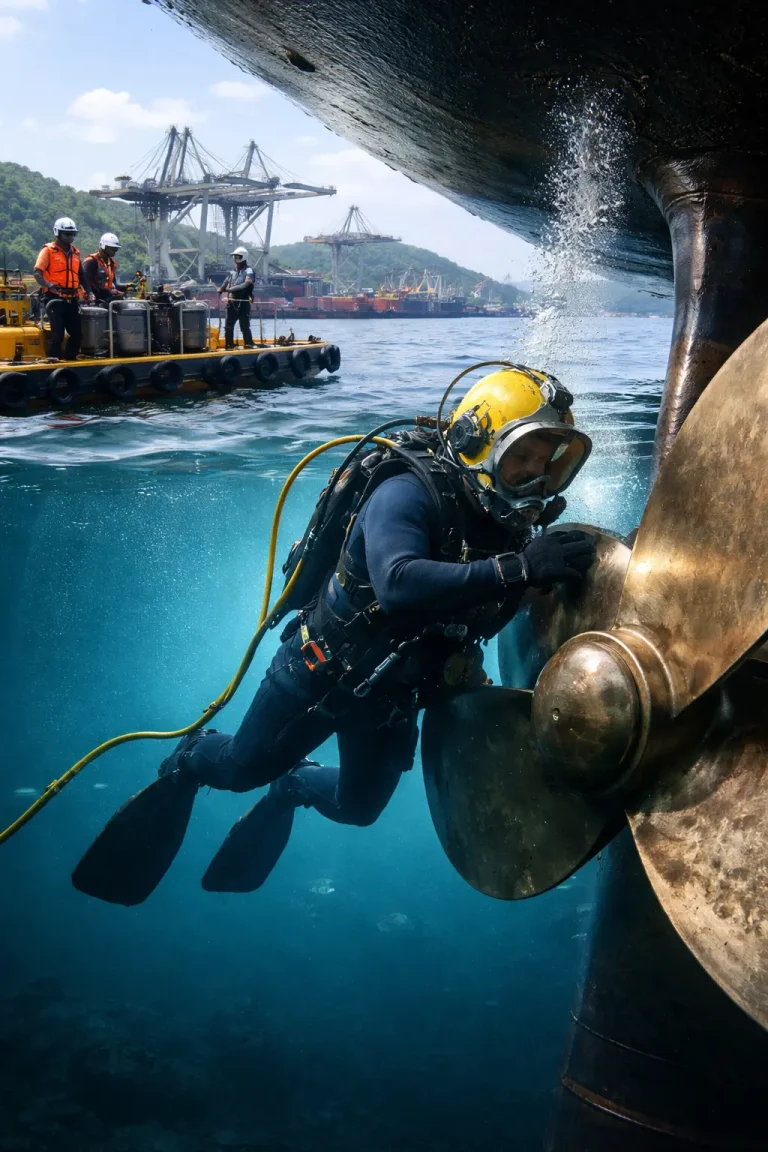
Overview
Indonesia’s maritime environment presents a unique combination of operational pressure: tropical waters, dense port activity, long sailing routes, and limited dry-dock availability. In this context, underwater inspection is not merely a visual check—it is a risk control tool that helps vessel operators maintain reliability while remaining operational.
Underwater inspection allows critical submerged areas of a vessel to be examined without removing the ship from service, providing timely insight into hull condition, fouling development, and underwater damage that could otherwise remain unnoticed.
Rather than reacting to findings during dry docking, operators can use underwater inspection to anticipate maintenance needs and reduce uncertainty.
Understanding Underwater Inspection
Underwater inspection is a structured visual assessment of a vessel’s submerged components conducted while the vessel remains afloat. The activity is carried out by trained commercial divers using underwater imaging and lighting systems designed for low-visibility environments.
Typical inspection focus areas include:
External hull surfaces
Biofouling accumulation and distribution
Propeller and shaft area
Rudder and steering components
Sea chests and intake grids
Sacrificial anodes
Thrusters and tunnels (if fitted)
The objective is condition awareness, not certification.
Why Underwater Inspection Matters in Indonesia
Indonesian operating conditions accelerate deterioration risks:
Warm seawater speeds up marine growth
Sediment-heavy ports reduce underwater visibility
Congested berths increase contact and impact risk
Long operational cycles delay dry docking windows
Without periodic underwater inspection, vessels may encounter:
Gradual loss of fuel efficiency
Unexpected underwater findings at dry dock
Increased cleaning or repair scope
Schedule disruption due to late discovery of damage
Underwater inspection acts as an early-warning mechanism, allowing operators to make informed decisions before problems escalate.
PSN’s Approach to Underwater Inspection
PT. Pancaran Samudera Nusantara delivers underwater inspection as part of its commercial diving operations, emphasizing practical execution and operational safety.
The inspection process is focused on:
Identifying visible anomalies
Observing fouling trends
Supporting maintenance planning
Providing clear visual evidence for technical review
All inspections are conducted by experienced diving teams operating under defined procedures and site-specific risk assessments.
Diving Operations Capability
PSN’s underwater inspection activities are supported by:
Certified commercial divers
Experienced diving supervisors
Surface-supplied diving systems
Continuous diver communication
Underwater video and still imaging
Portable lighting adapted to turbid waters
Each project includes job hazard analysis, toolbox meetings, and operational controls aligned with real port and anchorage conditions.
Inspection Reporting and Deliverables
Following inspection completion, PSN provides structured documentation that may include:
Vessel identity and inspection location
Environmental conditions during inspection
Areas accessed and observed
Photographic and video references
General condition notes
The report is designed to assist:
Technical teams in maintenance planning
Owners in operational decision-making
Cleaning and repair preparation
Long-term condition tracking
Inspection documentation is observational in nature and does not replace class surveys or regulatory inspections.
Common Use Cases
Underwater inspection by PSN is frequently applied for:
Routine condition monitoring
Pre- and post-hull cleaning checks
Damage assessment after berthing incidents
Propeller and rudder observation
Maintenance planning ahead of dry docking
Operational Coverage
PSN conducts underwater inspection services across Indonesian ports and offshore locations, including:
Jakarta
Batam
Belawan
Surabaya
Balikpapan
Makassar
Anchorage and offshore work sites
Mobile teams allow flexible deployment based on vessel schedules and port access.
Practical Value for Vessel Operators
Clients work with PSN for its focus on:
Operational realism
Safety-driven execution
Clear communication
Reliable manpower and equipment
Documentation that supports technical decisions
Rather than offering generic inspection outcomes, PSN emphasizes usable information aligned with vessel operations in Indonesian waters.
Closing Perspective
Underwater inspection is a strategic maintenance tool for vessels operating in Indonesia’s demanding marine environment.
By gaining visibility into submerged conditions while vessels remain in service, operators reduce uncertainty, improve planning accuracy, and avoid avoidable downtime.
PT. Pancaran Samudera Nusantara supports underwater inspection activities with experienced personnel, practical procedures, and a clear understanding of Indonesian maritime operations.
For inspection planning, schedule coordination, or operational discussion, PSN provides underwater inspection support tailored to real-world marine conditions in Indonesia.