Overview
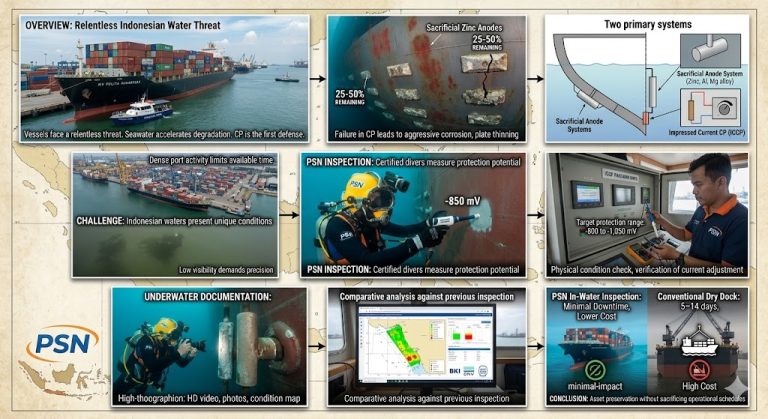
Vessels operating in Indonesian waters face a relentless threat of corrosion. Spanning more than 17,000 islands with busy shipping lanes from Sabang to Merauke, commercial vessels, tugboats, and offshore units are continuously exposed to seawater — an electrolytic medium that accelerates metal degradation at every moment of operation.
This is where the Cathodic Protection (CP) system serves as the first line of defense for hull integrity. Yet the system only performs effectively when its condition is monitored on a regular basis. PT Pancaran Samudera Nusantara (PSN) provides reliable in-water CP inspection services — without taking your vessel out of service for dry docking.
What Is Cathodic Protection and Why Does It Matter?
Cathodic Protection is an electrochemical corrosion control method applied to submerged metal structures. Two primary systems are used in the marine industry:
1. Sacrificial Anode System
Anodes made from zinc, aluminum, or magnesium alloy are mounted on the hull. These anodes corrode preferentially, sacrificing themselves to protect the steel hull plating beneath.
2. Impressed Current Cathodic Protection (ICCP)
An active system that delivers a programmed electrical current to the hull through dedicated electrodes, providing more precise and adjustable protection — particularly suited for larger vessels.
Failure in either system — depleted anodes, damaged ICCP electrodes, or inaccurate reference electrodes — can lead to aggressive hull corrosion, steel plate thinning, and structural breaches that are both costly and hazardous.
The Challenge of CP Inspection in Indonesian Waters
Indonesia’s waters present unique and demanding conditions:
- High salinity in the Malacca Strait and Java Sea accelerates corrosion rates
- Intense biofouling driven by warm tropical temperatures increases anode consumption
- Dense port activity at Tanjung Priok, Tanjung Perak, and Balikpapan limits available time for vessel inspections
- Low underwater visibility in certain port areas demands experienced divers with precise inspection techniques
These conditions make in-water CP inspection — conducted while the vessel remains operational or at anchor — the most time- and cost-efficient solution available.
PSN Cathodic Protection Inspection Services
PSN’s team of certified professional divers carries out comprehensive CP inspections covering:
Sacrificial Anode Visual Survey
- Estimation of anode consumption percentage (25–50% remaining = schedule immediate replacement)
- Identification of loose, cracked, or over-painted anodes that reduce system effectiveness
- Full anode distribution mapping across keel, rudder, propeller shaft, and stern tube areas
Hull Potential Measurement
- Deployment of underwater reference electrodes to measure hull protection potential
- Target protection range: -800 mV to -1,050 mV (vs Ag/AgCl) for carbon steel in seawater
- Detection of under-protected areas (insufficient negative potential) and over-protected zones (hydrogen embrittlement risk)
ICCP System Inspection (where fitted)
- Physical condition check of ICCP electrodes and reference electrodes
- Verification of no mechanical damage or sedimentation affecting system output
- Recommendation report for current adjustment to vessel electrical teams
Underwater Documentation
- HD video and high-resolution photography of all anodes and critical areas
- CP condition distribution map in standardized report format
- Comparative analysis against previous inspection data to track consumption trends
When Does Your Vessel Need a CP Inspection?
Key indicators that warrant an immediate CP inspection:
- The vessel has been operating for more than 12 months since the last CP survey
- Unusual discoloration observed on hull coating (reddish patches = early corrosion signal)
- Unexplained increase in fuel consumption (potentially linked to hull degradation)
- Vessel operating on routes with high seawater contamination, such as industrial port areas
- Abnormal vibration that may have dislodged mounted anodes
- Preparation for class certificate renewal from BKI, DNV, Lloyd’s Register, or other classification bodies
In-Water Inspection vs. Dry Dock: A Practical Comparison
| Aspect | PSN In-Water Inspection | Conventional Dry Dock |
|---|---|---|
| Operational Downtime | Minimal — vessel stays in service | 5–14 days |
| Cost | Significantly lower | High (dock fees + mobilization) |
| Mobilization Time | 24–72 hours | Requires long-lead scheduling |
| Inspection Coverage | Full submerged hull | Full hull |
| Real-World Conditions | Measured in actual operational state | Dry conditions differ from in-service |
Standards and Certifications
All PSN CP inspection operations are conducted in accordance with:
- IMCA D 018 – Diving Operations Manual
- NACE SP0176 – Corrosion Control of Steel Fixed Offshore Structures
- DNV-RP-B401 – Cathodic Protection Design
- IACS and BKI applicable regulations
PSN divers hold internationally recognized competency certifications with hands-on experience across bulk carriers, tankers, container vessels, offshore support vessels, and FSRUs.
Conclusion
A properly functioning Cathodic Protection system is a long-term investment in vessel asset preservation. When anodes are depleted undetected or an ICCP system underperforms, hull damage accumulates silently — until repair costs far exceed what a routine inspection would have prevented.
With PSN’s in-water CP inspection services, vessel operators across Indonesia can ensure hull corrosion protection remains at peak performance — without sacrificing operational schedules or revenue.